

80 Plus and Cybernetics: What Do Power Supply Ratings Actually Mean?
If you've gone shopping for PC parts before, you may have seen 80+ Gold or Cybernetics A+. But what exactly does that mean?How-To

Power supply wattage might be what you look at first when buying a new power supply, but arguably the PSU quality is more important. And thankfully, there's a quick and easy way to find out the quality: it’s rating.
 Photo: Jacob Bobo
 You’ve probably seen these before: the 80 Plus rating of Bronze, Silver, Gold, or Platinum (maybe even Titanium) or the newer Cybernetics rating with similar metallic themes. The question is, which one do you follow, and what do these ratings actually mean, anyway?
Here’s how the main ratings work, and what quality level you should consider for your next PSU upgrade. If you want to see which units we have available right now, here are the best PSUs we have.
What is 80 Plus?
The 80 Plus, or 80+, rating is a power supply efficiency ranking system developed by ClearResult that’s been around for over 20 years. Designed to encourage energy efficiency in power supply manufacture, the 80 Plus system was created to make sure that any certified power supplies could operate at 80% efficiency (wasting a maximum of 20% of the power it draws) at general use loads, like 20%, 50%, and 80% of the PSU’s capacity.
Although it started with a standard 80 Plus rating, this was expanded with Bronze, Silver, Gold, Platinum, and later Titanium and Ruby ratings. These demand stricter efficiency ratings, with the top models required to meet more than 90% efficiency at a wider range of loads.
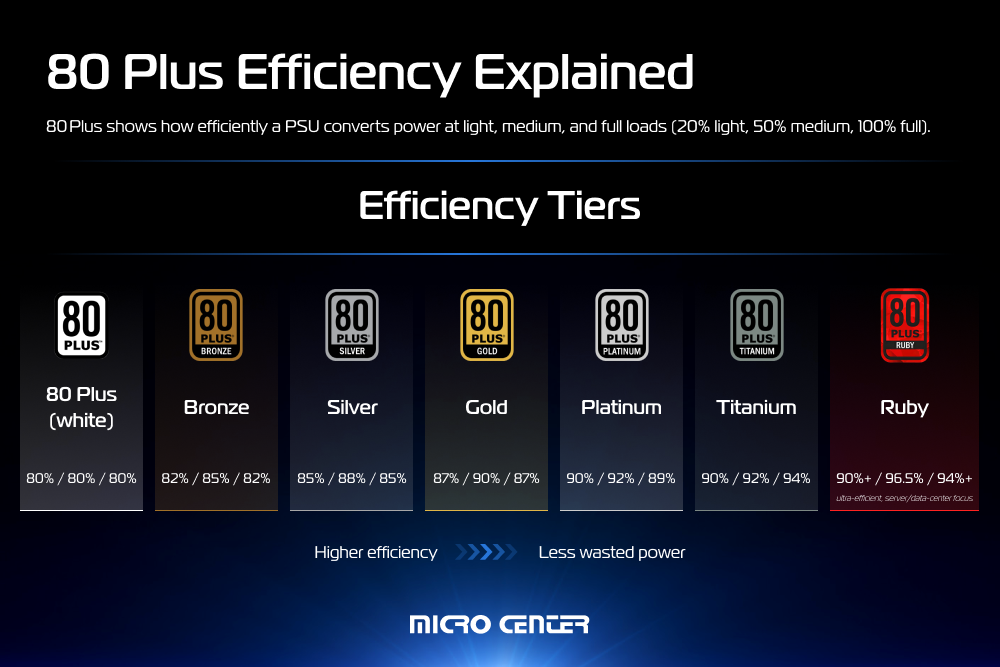 There are slightly different demands for the certifications at different voltages, with 230V EU PSUs demanding a couple of percent higher efficiencies across the board. For more details on that, check out the CleaResult page.
Although the 80 Plus rating system is primarily designed to inform you of a power supply’s efficiency, it also gives you a broad strokes idea of its overall quality. To achieve higher efficiency, power supply companies usually need to use higher quality components. You can rest assured that if you’re buying an 80 Plus Titanium or 80 Plus Platinum power supply, it will be of high quality.
That’s less true with Gold, Silver, Bronze, and 80 Plus (non-metallic) ratings, but the higher in efficiency you go, usually, the higher the PSU’s quality.
You can find out a range of details about a PSU’s 80 Plus rating using the CleaResult PSU database.
Cybernetics PSU ratings explained
Cybernetics is a newer PSU ratings system that provides certification for PSU efficiency, but also rates power supplies by noise levels, too. In a similar and familiar fashion to 80 Plus, the Cybernetics rating system also uses metals to denote quality. It starts with Bronze, moving through Silver, Gold, and then Platinum, Titanium, and Diamond at the top end.

Where the 80 Plus rating system specifies efficiency ratings at different load capacities, Cybernetics bundles it altogether into “Overall efficiency.” However, it also tracks a “Power Factor” rating, which is effectively an additional efficiency rating; 5VSB efficiency, which tracks the efficiency of a power supply’s 5VSB rail, and Vampire Power, which is how much power the unit uses in standby mode.
Cybernetics also tracks noise ratings, and offers tested PSUs a rating from Standard, through Standard+, Standard++, A-, A, A+, and A++ ratings, with units ranging from between 40 and 45 decibels, to as quiet as sub-15 decibels.
As with 80 Plus ratings, none of these can give you 100% the story about a power supply’s quality and how well it will power and protect your components. However, the ratings do have some correlation with that quality, so higher rated PSUs will almost always be higher quality than lower rated ones. With the additional information and stipulations of Cybernetics ratings, they could prove more useful in determining how right a PSU is for your next upgrade.
You can find all the stats on any of Cybernetics’ rated PSUs on its easily-searchable database, making it a useful resource anytime you’re buying a power supply.
Frequently Asked Questions About PSU Ratings
What about PPLP?
PSU Performance Level Plan, or PPLP, is another ratings system that a select few power supply manufacturers use to classify their units. It’s not widely in use yet, but does show some promise for giving us greater insight into PSU quality. It’s useful as an additional vote of confidence in a unit, but we’d focus on the 80 Plus or Cybernetics ratings for PSU comparison for the time being, or until PPLP is more widely used.
Which PSU rating should I go for?
When I’m buying a new PSU, it has to have at least an 80 Plus Gold rating and ideally, Cybernetics Gold rating too. That’s not a 100% guarantee the PSU will be of the kind of quality I’m looking for, but a PSU with that rating from a highly respective brand is enough to tell me that the PSU should be of at least decent quality.
If you want a PSU that’s more efficient, or is made from even higher quality components, then getting a unit that’s rated 80 Plus and/or Cybernetics Platinum, is excellent. However, if you’re going to leave a PC idling the majority of the time, getting a unit that’s Titanium certified from either rating’s body is worth the time, as it’s the only one that mandates a high efficiency rating at just 10% load. That could end up saving you money on energy bills in the long run.
For ultra budget builds, don’t consider any less than 80 Plus Bronze. Outside of that rating, you’re really running the risk of using a PSU that may do serious damage to your system if it fails.
Are there any other ways to find out a power supply’s quality?
There are a few extra techniques you can use to determine if a power supply is a quality, efficient unit, beyond the efficiency ratings. For starters, consider the brand name. If it’s made by an established, respective PSU manufacturer, then there’s a higher chance it’s of quality construction. If you don’t recognize it, you’re better off looking elsewhere.
Strong PSU manufacturers include: Asus, be quiet!, Corsair, FSP, NZXT, Montech, Silverstone, Seagate, Super Flower, Thermaltake, Bitfenix, Enermax, Cooler Master, Antec, EVGA, Fractal Design, Phanteks, and Silverstone, among others.
You can also look to community-led PSU tier lists, which tend to offer comprehensive backgrounds on a range of power supplies. They don’t always get to every unit and they can be a little heavy on information making them harder to read, but they’re a great resource for checking out a power supply you’re considering.
Don’t neglect checking individual reviews for power supplies, too. Although few publications have the technical hardware to really test a PSU, they can be another useful resource in double checking your work when it comes to selecting the right PSU for you. They’ll often point out subjective or personal-use features that you may not be able to get from a specification sheet.
Finally, you can always ask one of us here at Micro Center. If you’re not sure what the right PSU for you and your next upgrade is, give us a call or pop into your local store and one of our power supply experts will be happy to walk you through your options and what’s best for you.
More from MC News
- Run AI Locally: The Best LLMs for 8GB, 16GB, 32GB Memory and Beyond
- Quantization Explained: Why the Same LLM Gives Better Results on High-End Hardware
- Why VRAM and Memory Bandwidth are Key for Powering Local AI
- Hands-on with NVIDIA DGX Spark: Everything You Need to Know
- How to Build a PC with a Hardline Water-Cooling Loop
- 3D Print a Mac Mini Monitor Mount
- The End Has Come for Windows 10: Four Tips to Make the Most of Windows 11
- Everything You Need to Know About WiFi 7
- Keyboard 101: Intro to Computer Keyboards
- Fix It Yourself: Talking to iFixit on Why Repairable Tech Matters
Jon Martindale is a freelance technology journalist and writer from Gloucestershire, UK. He's written for a range of publications over a 20-year career, including DigitalTrends, USNews, Forbes, and Lifewire, among many others. Over that time he's written countless how-to guides, best-of lists, hands-on reviews, and in-depth op/ed features.
He has been building and working with computers since his teens, and loves nothing more than trying out the latest components and gadgets to see what they can do. When he isn't staring at a monitor, he can be found chasing after with his two young children, playing board and roleplaying games, or walking his French bulldog cross.


