
An Expert Guide to AMD Processors
With its revolutionary X3D chips for gaming, impressive power efficiency, and user-friendly overclocking, here’s a look at what AMD’s processors bring to the table.Buying Guides

In the world of desktop processors, AMD is positioned as a major force, driving innovation and competition with its powerful CPUs. The company’s latest Ryzen 9000 series and groundbreaking X3D chips for gaming offer compelling performance for everyone from budget-conscious builders to hardcore enthusiasts.
 Photo: Micro Center
If you're considering an AMD chip for your next PC, here's what you need to know.
A Brief History of AMD
AMD, or Advanced Micro Devices, was founded in 1969 (just one year after Intel) by Jerry Sanders and several of his colleagues from Fairchild Semiconductor. It produced a range of chips and components in its first few years, ultimately releasing a reverse-engineered version of Intel’s 8008 CPU in 1975, known as the Am9080.
AMD went on to do a deal with Intel in the 1980s to produce Intel CPUs and act as a second-source manufacturer for partners. In the 1990s, it would start producing its own x86 processors, competing directly with Intel for the first time.
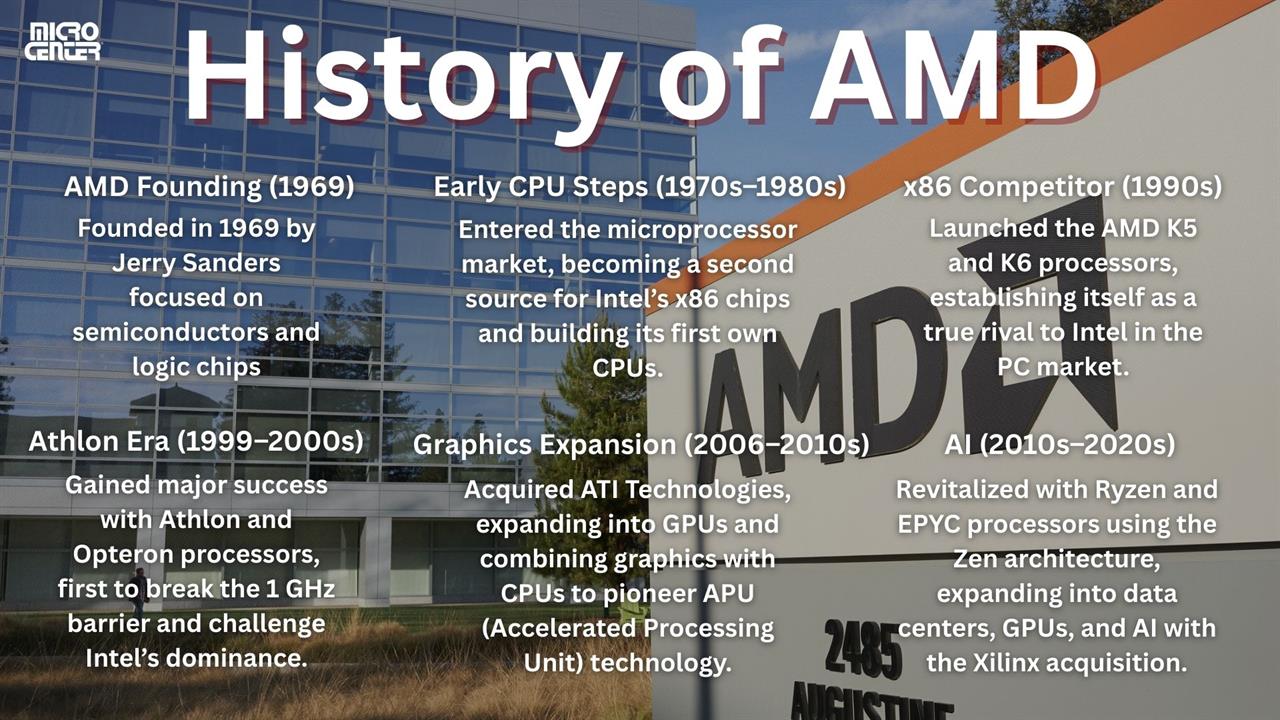 Photo: Micro Center
After a period of dominance in the early 2000s, the company reignited the competition in 2017 with the launch of its first-generation flagship Ryzen CPUs.
Unmatched gaming performance
AMD has carved out a distinct advantage in gaming, thanks in large part to its innovative 3D V-Cache technology. AMD’s X3D CPUs like the 9800X3D and 9950X3D often take the lead in gaming benchmarks and in tasks that rely on fast access to a large amount of cache. These X3D chips can really make the most of the capabilities of high-end graphics cards.
And while gaming is a major focus, AMD’s CPUs are also absolute powerhouses for productivity, particularly in applications that are optimized for up to 16 cores.
If you want a more powerful gaming system without using a dedicated graphics card, AMD’s accelerated processing units (APUs) combine both a CPU and a GPU on the same piece of silicon, and are found in devices including the latest Xbox and PlayStation consoles and handheld PC gaming systems like the Steam Deck or Legion Go.
 Photo: Micro Center
Focus on efficiency
AMD’s latest Ryzen 9000 CPUs offer excellent energy efficiency – particularly with its lower-core-count X3D models, like the 9800X3D and 9900X3D. Part of this is down to the compact 4nm process node AMD used for this generation, but the architectural design also lends itself to lower power draw.
This efficiency means the chips produce less heat, making them easier to cool. Additionally, AMD’s popular Eco mode allows users to limit power consumption without a major impact on performance, a useful feature for managing both system thermals and energy bills.
Unlocked for enthusiasts
AMD takes a very user-friendly approach to overclocking. If you want to manually overclock AMD CPUs, you can tweak the frequencies of just about any CPU across its recent generations as almost all of them support overclocking. The same goes for most AMD motherboards too.
The performance gains will depend on your cooling and the particular CPU you have, but you can unlock some additional performance using tools like the Ryzen Master utility and features like Precision Boost Overdrive.
Processor pricing and value
Entry Level
AMD’s current-generation entry level options are more limited than generations past. Its Ryzen 5 9600X and 9600 represent the lowest-tier CPUs (skipping the Ryzen 3 series of older generations). These CPUs have six cores a piece for 12-thread support and can reach clock speeds of 5.4 and 5.2 GHz, respectively.
Mid-Range
AMD’s mid-range arguably covers the 9600X model, but we’d also include the last-generation 7700X. It lacks some of the latest AMD architectural improvements, but it still has eight cores and a 5.4 GHz clock speed. You can find it for under $250 these days, too.
High-End and Enthusiast
AMD’s high-end CPUs start with the 9700X: It’s the current-generation version of the 7700X, with eight cores and the newest Zen 5 architecture. The 9800X3D is the most impressive eight-core CPU of its generation, though, combining the latest chip design with AMD’s 3D V-Cache for incredible gaming performance. There’s also a 16-core version, the 9950X3D, which offers similar gaming performance with competitive productivity capabilities, too. The 9900X3D offers a 12-core middle ground between the two.
AMD also has X3D-less options for more affordable alternatives. The non-X3D 9950X is excellent for professional workloads, with its 16 Zen 5 cores and 5.7 GHz boost clock, while the 9900X is a 12-core alternative for more-affordable pro use.
Upgrades and future plans
One of AMD’s most compelling advantages is its commitment to a long-term upgrade path. AMD’s Ryzen 7000 and 9000 CPUs are based on AMD’s AM5 socket, which should have at least one more generation of direct CPUs, but could also have more. AMD has pledged to support it through 2027 at least, so there will be future drop-in CPU upgrades you can use, rather than having to upgrade your motherboard.