
AMD's Ryzen AI Halo will be an AI Mini-Desktop with Serious Power

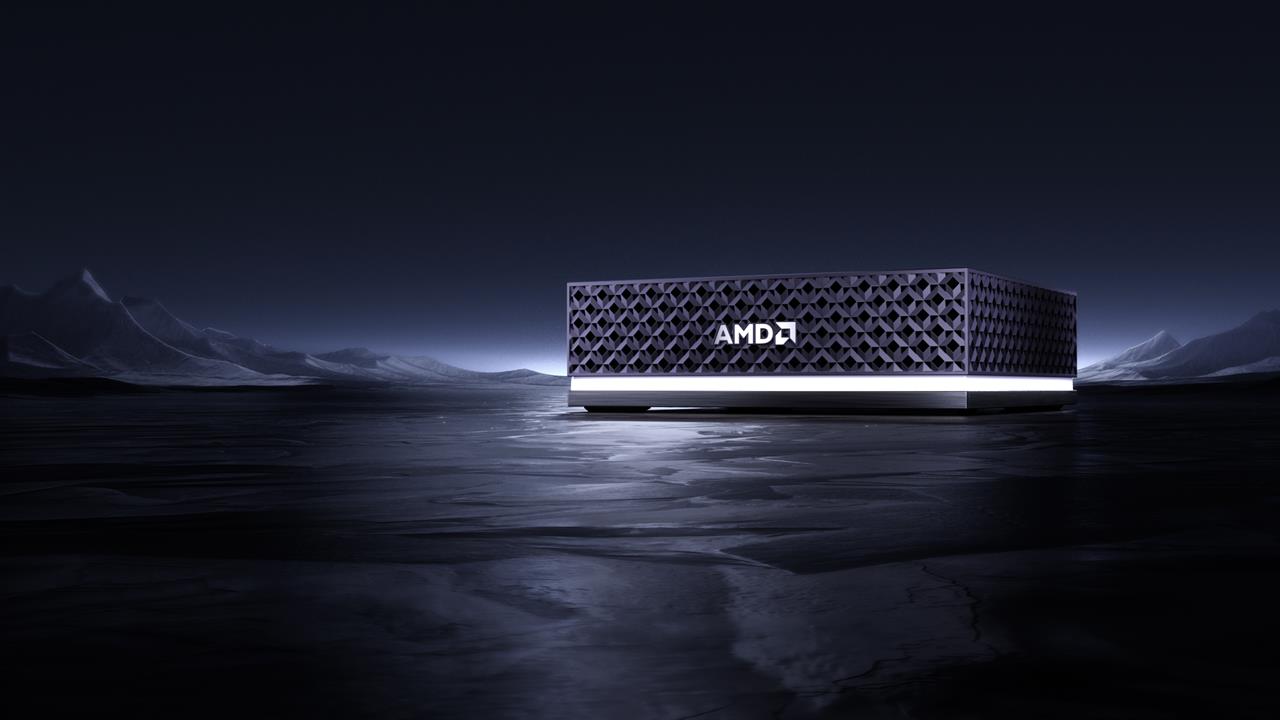
Photo: AMD
AMD came out swinging at Computex 2026, and one of its strongest moves was the company's new Ryzen AI Halo Developer Platform.
Essentially an AI mini-desktop powered by the company's Strix Halo (and, later this year, Gorgon Halo) chips, Ryzen AI Halo looks on paper like it will immediately become a top option for developers and enthusiasts looking to run AI at home. The Ryzen AI Halo is available to pre-order now. It's a Micro Center retail exclusive and will be in stores on July 10.
AMD is also leaning heavily on agentic AI models that take actions for users autonomously. The release of open-source agentic AI tool OpenClaw popularized agents, but they don't work well when powered by the small, limited local LLMs that a typical consumer laptop or desktop can run. Ryzen AI Halo's performance and large memory capacity could make it ideal for running agents at home.
Ryzen AI Halo has the specs
AMD's Strix Halo silicon, which is sold as AMD Ryzen AI Max, was revealed back in 2024 and released in a wide range of laptops through 2025. It's a great choice for AI workloads because it has a unified memory architecture with up to 128GB of memory and a powerful integrated GPU with up to 40 compute units. It has enough memory to load a fairly large LLM and enough compute performance to run it at reasonable speeds.
The debut AMD Ryzen AI Halo will offer a single configuration. It includes an AMD Ryzen AI Max+ 395 with 16 CPU cores, AMD Radeon 8060S graphics with 40 compute units. This is the most powerful configuration of AMD Ryzen AI Max hardware available. That's paired with 128GB of LPDDR5X-8000 memory and a 2TB solid state drive.
And it runs Windows (or Linux)
AMD's Ryzen AI Halo Developer Platform can ship with Windows 11 Pro pre-installed, or it's also available with Linux.
Linux is great if you want to run a headless AI server accessible on other devices (which can include an AI agent). However, if you have any desire to use your AI desktop as a more general-purpose PC, Linux can be more difficult to use. Apple's MacOS, on the other hand, tends to be more tied down and difficult to work with when it comes to using a computer as an AI server or agent. Windows strikes a middle ground.
With that said, Ryzen AI Halo also supports Linux, so you can choose the operating system that works best for you.
The first AI Halo is impressive. Its successor could be killer
The Ryzen AI Halo Developer Platform with Strix Halo is a powerful option for AI, but its eventual successor will raise the bar.
AMD plans to launch Ryzen AI Halo with refreshed Gorgon Point silicon (which will be sold as the Ryzen AI Max 400) in Q3 2026. It will be available in three variations, which include:
- Ryzen AI Max+ Pro 495: 16 CPU cores and 32 threads, up to 5.2GHz boost clock, 40 graphics CUs
- Ryzen AI Max Pro 490: 12 CPU cores and 24 threads, up to 5GHz boost clock, 32 graphics CUs
- Ryzen AI Max Pro 485: 8 CPU cores and 16 threads, up to 5GHz boost clock, 32 graphics CUs
The introduction of Ryzen AI Max Pro chips with fewer CPU cores and graphical compute units should let AMD address a wider range of price and performance than its competitors.
Perhaps the most notable hardware change, however, is Gorgon Point's expanded memory support. AMD Ryzen AI Max 400 chips can address up to 192GB of unified memory—of which 160GB can be dedicated to AI. AMD says this will make it possible to run AI models with up to 300B parameters.
There's one final wrinkle. Unlike the first AMD Ryzen AI Halo Developer Platform, the desktops based on AMD Ryzen AI Max 400 will be available from several PC makers including Asus, HP, and Lenovo.
AMD says it's ready out of the box
As mentioned, one of the two versions of AMD's Ryzen AI Halo Developer Platform ships with Windows—which should make it easier to use. And that's not the only way AMD is trying to improve usability.
AMD is shipping the AI mini-desktop with software called the Ryzen AI Halo Developer Center. This software will help users get started with common use cases for a local AI desktop. This includes not only setting up an LLM but also installing image diffusion models and generating images through common clients, such as ComfyUI.
While the Developer Center is software, you can get a look at some of what it offers on AMD's AI Playbooks website. This website (which also has playbooks for running AI on AMD Radeon GPUs and AMD Ryzen AI APUs) includes several dozen detailed tutorials.
And while I haven't used the AMD Ryzen AI Halo Developer Platform myself, I have used AMD's AI Playbooks to experiment with AI on my desktop, which has an AMD Radeon 7800 XT video card. The state of play has definitely changed even in the past year. A wide range of LLMs and diffusion models now run well on AMD hardware.
To further this goal, AMD has partnered with HuggingFace to improve the compatibility of common AI models and tools with AMD hardware. The results of this partnership remain to be seen, but HuggingFace says it will "optimize key models" for AI hardware and integrate the AMD ROCm SDK (which can be used to accelerate AI workloads on AMD hardware) into its open-source libraries.
OK, but what can it do?
AMD says the Ryzen AI Halo Developer Platform can handle a wide range of LLMs, as well as other AI tasks. But what does that mean in practice?
Fortunately, this is easy to find out. Strix Halo and the AMD Ryzen AI Max+ 395 were released last year, and PCs based on it have received dozens of reviews. I've personally reviewed several machines with variants of this hardware, such as the recently released ASUS TUF Gaming A14 with Ryzen AI Max+ 392.
The Ryzen AI Max+ 395 is a good fit for local LLMs up to roughly 40 billion parameters (when paired with 96 to 128GB of memory). It can load larger models, to be sure, but the available compute performance and memory bandwidth aren't enough to run a larger model at more than a dozen tokens per second.
One of the best real-world benchmarks I've found comes from this owner of a Ryzen AI Max+ 395 system with 128GB of memory, who tested 10 different LLMs on the hardware. The smallest models (less than 10B parameters) produced 40 to 80 tokens per second, but extremely large models (up to 70B parameters) were in the single digits.
Software optimizations may squeeze a bit more performance out of the Ryzen AI Halo Developer Platform, but in my experience these figures remain a good benchmark. It's technically possible to load very large models on AMD Ryzen AI Max hardware, but LLMs with 10 to 40 billion parameters tend to make the best compromise between model quality and speed.
Still, as I've recently reported, models in this range are a lot more capable than they used to be and now benchmark at a level similar to OpenAI's o1 and Anthropic's Claude 4.
I don't think it's realistic to expect a Ryzen AI Halo Developer Platform running an agentic LLM to vibe-code a complicated software tool end-to-end. However, it should be able to handle shorter tasks, like an app with just a few features, or a single feature in a larger app.
This is an AI mini-desktop to watch
Assuming the software is solid, Ryzen AI Halo Developer Platform is going to be an AI mini-desktop to watch. AMD's Strix Halo is proven hardware that's known to provide competitive AI performance, and the launch version of the Ryzen AI Halo box undercuts the alternatives on price.
More from MC News
- Run AI Locally: The Best LLMs for 8GB, 16GB, 32GB Memory and Beyond
- Quantization Explained: Why the Same LLM Gives Better Results on High-End Hardware
- Why Context Length, Not AI Model Size, Is Your Biggest VRAM Problem
- How to Use LM Studio to turn your PC into an AI Server
- Why VRAM and Memory Bandwidth are Key for Powering Local AI
- Keyboard 101: Intro to Computer Keyboards
- Fix It Yourself: Talking to iFixit on Why Repairable Tech Matters
- The Local LLM Your Laptop's Been Waiting For
- Gemma vs Qwen: Which Local AI is Best?
Matthew S. Smith is a prolific tech journalist, critic, product reviewer, and influencer from Portland, Oregon. Over 16 years covering tech he has reviewed thousands of PC laptops, desktops, monitors, and other consumer gadgets. Matthew also hosts Computer Gaming Yesterday, a YouTube channel dedicated to retro PC gaming, and covers the latest artificial intelligence research for IEEE Spectrum.